
Laozi and the Tao Te Ching: Finding Mindfulness in Taoist Wisdom

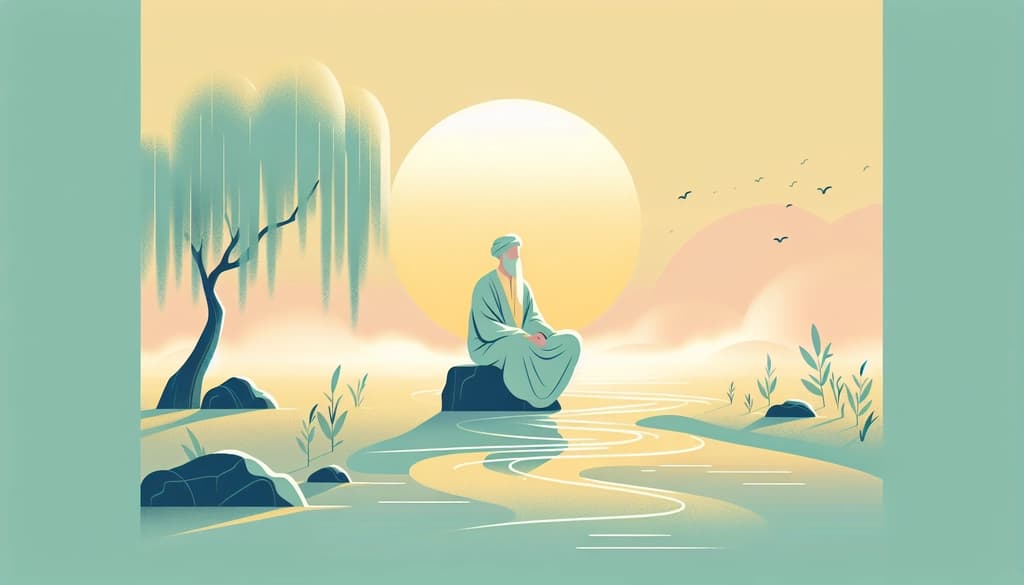
You may have heard that the Tao Te Ching holds answers for the restless heart. But have you ever noticed, on days when your thoughts tumble and scatter, how the sound of a distant river can pull you gently back to yourself? This is the spirit Laozi describes — a soft strength, the way water wears smooth the sharpness of stone, shaping the world without force.
Much of Laozi’s philosophy embodies fundamental Taoist teachings on flow, which offer us subtle pathways back to the quiet pulse beneath thought and routine. To study these teachings is not to escape life, but to live alongside it with renewed gentleness.
Listening to the Quiet Way
Taoist wisdom invites us to turn inward, not in retreat, but in a listening that holds the world with tender curiosity. The teachings of Laozi arrive like a poem at the end of a long journey: “Do you have the patience to wait till your mud settles and the water is clear?” What if you allowed this waiting, letting each breath mirror the clarity of still water?
- Feel the inhale travel in, as if drawn from a mountain spring
- Notice the pause, where silence gathers between thoughts
- Exhale slowly, releasing the striving and letting weight drop into the earth
The Way of Effortless Being
Laozi speaks to the wisdom of not-doing — wu wei. This is not passivity, but a mindful abiding through all seasons. Imagine tending a garden: there is labor, but there is also trust in rain and sun. In life, can we allow what unfolds without forcing change, meeting each moment with presence rather than control? In this spirit, the uncarved block metaphor arises—Laozi’s image for the natural wholeness at the heart of Taoism. It reminds us to let go of unnecessary shaping and return to the simplicity of being.
This concept is also described as the uncarved block metaphor, inviting us to experience the freshness and purity of unconditioned presence.
- Let your attention move like water, yielding around difficulty rather than colliding
- If restlessness stirs, pause and sense the steady pulse of your own heartbeat
Nature’s Metaphor: The Tao in Everyday Life
When clouds gather and scatter, or wind rustles through tall grasses, we witness the essence of Tao: changing, yielding, yet never broken. Mindfulness, in the Taoist view, is a soft returning — not to some future state, but to the freshness of this single moment. Even waiting in uncertainty, there is spaciousness; the next breath a soft beginning.
Across centuries, the Tao Te Ching’s influence on mindfulness has embodied this gentle wisdom: encouraging us to notice the living relationship between thought, breath, body, and the always-changing world.
- Notice the quality of light in your room, and the temperature of the air on your skin
- Attend gently to the rising and falling of your mood, without judgement
- Let your next breath be a return to the stillness that is always present — the source, the Tao.
We can also see echoes of Laozi’s vision in places shaped for quiet—like Zen gardens and Taoist serenity. These spaces invite us, much like the Tao itself, to meet each day with openness rather than expectation.
In reading Laozi, as in sitting quietly by the water, we sense the wisdom of enough, the grace of letting be. Mindfulness is not a mountain to climb, but a river to enter — wherever we are, exactly as we are. The Tao Te Ching reminds us: true softness is the source of real power. In this remembering, we are never separate from the living current, immersed in oneness in Zen and Taoism, and held by a source that flows through all things.
Understanding the teachings of Laozi highlights the heart of oneness in Zen and Taoism: an invitation to return—not just to ourselves, but to a wider belonging shared with all life.
FAQ
You May Also Like

Taoist Wisdom and the Art of Flow in Mindfulness
Sometimes presence feels like water in the hand—here, then gone, shaped by the smallest tension. Taoist teachings invite us to return again and again to this gentle flow, where effort softens and the way forward becomes clear without striving.

Tao Te Ching Lessons for Work-Life Balance in Modern Life
In the thrum of modern life, the old words of the Tao Te Ching whisper of another pace—unhurried, attuned, quietly wise. What if work-life balance began not with scheduling, but with honoring the nature within and around us?