

Finding the Middle Way: Buddhist Balance for Modern Stress

The world seldom pauses. Light spills through skyscraper windows before most of us have had a moment to collect our thoughts. There's a hum in the chest, a tension at temples, the mind’s calendar already cluttered before breakfast. The body holds subtle evidence of striving—shoulders tight, jaw set, heart persisting at a quiet gallop.
The Buddhist teaching of the middle way arose in a wilderness not so different from our own. Instead of traffic and notifications, there was hunger, heat, and the uncertainty of another day on the road. The extremes change, but the search for balance—called ‘madhyamā pratipad’—remains: How do we meet the world without collapsing or hardening? For many, addressing modern stress through mindfulness is often made easier by recognizing and gently applying these ancient strategies for equanimity.
Where Stress Takes Hold
Some days we live on the far edges—driven by ambition until we are spent, or retreating until we feel numb. Stress can draw us into rigid patterns: chasing perfection, avoiding discomfort, believing there is only “all in” or “all out.” What if balance meant coming home to the quiet sense of “enoughness” between these poles? This is the heart of the Buddhist Middle Way, offering timeless guidance amid the flux of daily life.
Try pausing and listening—not just to the mind’s agitation, but to the subtle textures of your own body. Where does tension speak most? What happens as you breathe out? Each sensation is a messenger, inviting inquiry: “Is there another way of being with this?”
The Middle Way in Practice
Walking along a pond’s edge, each step could be a conversation between firmness and ease. The middle way is not a tightrope to perform on, but a gentle arc—each moment a balancing act, yet also an act of letting go. It does not demand silence from the mind or the vanishing of emotion. Instead, it asks for presence: Can I notice both effort and rest, fear and softening, without gripping either? In the midst of this inquiry, integrating prajna into modern mindfulness can deepen your capacity to meet challenge with a wise, grounded clarity.
- Feel the breath—its natural length, neither forced nor shallow
- Notice where the body holds back or pushes ahead
- Let thoughts rise and fall, like reeds swaying in wind
- Ask softly: “What might balance feel like here?”
Balance, in its essence, is not static but responsive—like tree branches that bend while never breaking. Applying the middle way to modern stress doesn’t mean mediocrity or detachment. Rather, it becomes a movement toward wholeness: recognizing what is needed now, how much to hold, when to release. This living approach echoes the art of perseverance as a mindful virtue, where effort is tempered by wisdom and compassion.
Nature as a Mirror
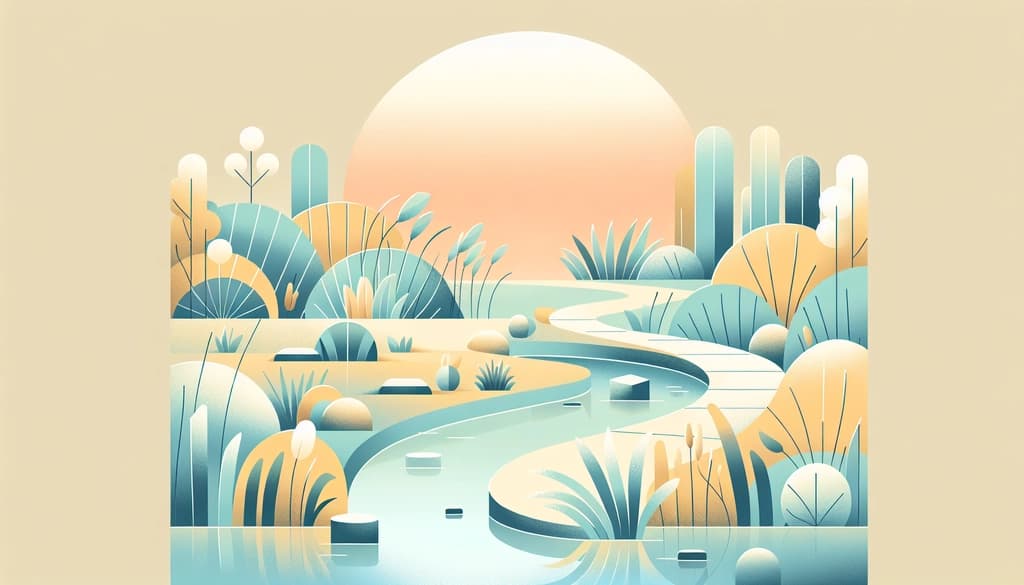
Look to the natural world. A stream cuts through earth not by brute force, nor by disappearance—but by adapting with each stone, every turn. Stress is neither to be vanquished nor worshipped. It becomes landscape; we walk alongside it, choosing a way that is neither resistance nor collapse, but a conscious, embodied in-between. Sometimes, embracing the virtue of balance in the Middle Way is foundational to both renewal and resilience.
In moments of overwhelm or fatigue, let your next breath be a soft beginning. Balance is not found once, then kept. Like the arc of a day—dawn to dusk—what matters is a willingness to meet it, again and again.
“Between striving and surrender, a quiet current moves. This is the living balance.”
FAQ
You May Also Like
Early Buddhist Texts: Returning to the Roots of Mindfulness
When we listen inwardly, something ancient stirs beneath our modern longing for mindfulness. The earliest Buddhist texts, grounded in earth and breath, offer a living wellspring of wisdom that endures beyond fleeting trends.
Digital Detox and Mindful Living: Finding Balance in a Wired Age
Screens are everywhere now, their gentle pulse drawing attention again and again. In this quiet space, we wonder: what remains when we unplug, even for a breath or an afternoon?

Tao Te Ching Lessons for Work-Life Balance in Modern Life
In the thrum of modern life, the old words of the Tao Te Ching whisper of another pace—unhurried, attuned, quietly wise. What if work-life balance began not with scheduling, but with honoring the nature within and around us?

Free Will and the Tides of Mindfulness in Buddhism
We often wonder—am I truly choosing each thought, or am I carried along by older currents within? In the gentle light of Buddhist mindfulness, the question of free will becomes both a doorway and a resting stone.